Why Cheap Tiers Feel Expensive at High Volume
The phrase "cheap tier" measures one variable and quietly assumes the rest hold still. At high volume they do not. This piece deliberately works without money figures — none are part of the data behind it — and instead uses the three units a text chat actually consumes: messages, sessions and hours.

Key takeaways
- Volume varies enormously between readers: 10 messages a day is 300 a month, while 120 a day is 3,600 — a twelvefold gap.
- Reach is not retention. The three leading cards sit at 0.029%, 0.015% and 0.026% for favourites divided by views.
- Budget attention in hours: 16 sessions a month is 4.0 hours at 15 minutes, 8.0 at 30 and 16.0 at 60.
- Measure your own efficiency as saves per opened card, not messages sent. Volume alone is not a result.
Why volume breaks low-volume assumptions
Any arrangement looks comfortable when it is barely used. A reader who sends ten messages a day sends about 300 in a month, and at that pace almost any structure fits. The same arrangement meets a different reality for a reader sending 120 messages a day, which is 3,600 a month — twelve times the volume.
That ratio is the reason a category claim like "cheaper is better" travels so badly. It is not wrong so much as incomplete: it optimises the smallest number in the equation while the largest number, the volume you actually produce, goes unmeasured.
The honest fix is to find your own figure first. Count messages and sessions for one week, multiply by four, and write the result down. Every later decision about which arrangement suits you gets easier once that number exists, and much harder until it does.
The numbers that scale with use
Volume translates into time more directly than most readers expect. Fifteen seconds of attention per message is a modest assumption, and it turns a light habit into about 1.25 hours a month while a heavy one becomes roughly 15 hours.
Sessions scale separately. Sixteen visits in a month is 4.0 hours at 15 minutes each, 8.0 hours at half an hour and 16.0 hours at a full hour, so the same number of visits can describe a light month or a heavy one depending on how long each runs.
Fifteen seconds per message is a deliberately conservative assumption. If a heavier habit takes 30 seconds of thought instead, the same 3,600 messages become 30 hours in the month, which is the point at which an arrangement has to be chosen around the habit rather than the other way round.
Both figures matter because they are the ones that change when volume changes. An arrangement that fits 300 messages comfortably can be strained by 3,600, and the strain usually shows up as time rather than as anything else.
| Level | Messages a day | Messages a month | Illustrative hours a month | What it demands |
|---|---|---|---|---|
| Light | 10 | 300 | About 1.25 | Almost any arrangement will fit |
| Moderate | 40 | 1,200 | About 5.0 | A routine that keeps the volume inside the week |
| Heavy | 120 | 3,600 | About 15.0 | A deliberate plan, because the hours stop being incidental |
Worked example: reach against retention
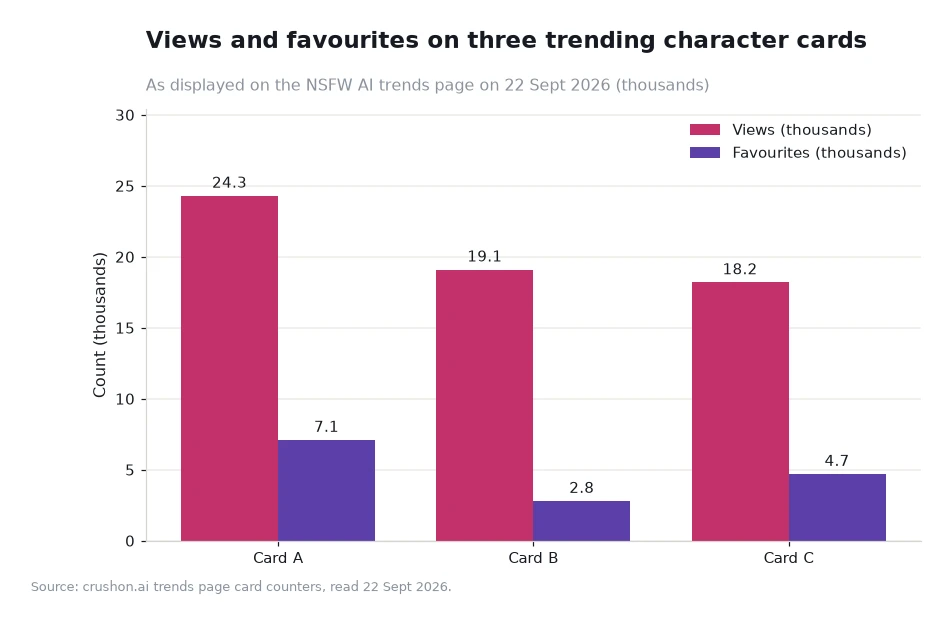
Volume has a second lesson hidden in the counters, and it is about mistaking activity for value. The three leading cards on the trends page show 24.3M views with 7.1K favourites, 19.1M with 2.8K, and 18.2M with 4.7K. Divide each pair: 0.029%, 0.015% and 0.026%.
Large reach sits behind small retention in every case. The first card needs roughly 3,400 views to produce one deliberate save, the second about 6,800 and the third about 3,900. Nothing about the size of the audience tells you how much of it stayed.
The same trap applies to your own numbers. Sending 3,600 messages is impressive volume and an uninformative result; what matters is how many characters you kept from them. Compare saves with opened cards, and a ratio near one in four suggests a shortlist is doing its job, while a month of opens with no saves suggests the volume was going into trials that should have been rejected earlier.
Where the plan question belongs
Once you have your own message count and session hours, a page about arrangements becomes readable in a way it is not before. That is the order to work in: measure first, then read. The platform's unlimited plan page is the place to do that reading, and the useful comparison is between its options and the volume you wrote down, not between its options and each other.
The wider product page frames the same question in non-financial terms. The porn ai chat page lists customizable characters, privacy and discretion, and responses that recall earlier interactions, and it answers the naming question in its FAQ by using AI Porn Chat and Porn Chat AI interchangeably. Crushon's structure is the part that decides whether high volume feels like a routine or a chore: saves, recall and a shortlist are what make a heavy month repeatable.
There is a third page worth keeping handy once a log exists. The AI chat blog covers prompting and pacing, which is what a reader needs when the log shows a large message count and very few saves — the signature of a heavy month spent starting things rather than continuing them.
What a heavy month looks like in the log
Once volume is measured, the second question is whether it is producing anything. A log for a heavy month needs only four entries a week: messages sent, sessions opened, characters kept and hours spent.
At 3,600 messages and sixteen sessions, that log shows whether the volume is going into one or two characters or being spread across a dozen. Spread volume is the pattern that makes a low-volume arrangement feel strained, because each of the dozen receives enough attention to start and not enough to continue.
The log also produces a figure most readers have never worked out: minutes per kept character. Divide the month's hours by the number of saves and you get the real time cost of a shortlist. At 8.0 hours across two saves that is four hours each, which is either excellent value or an argument for testing candidates faster, depending on how those two characters turned out.
Two habits follow from that number. Reject cards in the first five messages rather than in the first fortnight, and keep the count of active characters small enough that each one still gets a full session occasionally. Volume is not the problem by itself; volume with no shortlist behind it is.
Frequently asked questions
Why does a low-cost option stop suiting heavy users?
Because the claim assumes a small volume. Going from 10 messages a day to 120 is a twelvefold increase — 300 to 3,600 a month — and arrangements that felt effortless at the lower figure are simply untested at the higher one.
How should I measure my own usage?
Count messages and sessions for a week and multiply by four. At 40 messages a day that is about 1,200 a month, or roughly 5 hours at 15 seconds per message.
What number tells me whether the month went well?
Saves per opened card. Reach is not retention — the leading trends card converts views into favourites at 0.029% — so a month with fewer opens and more saves is usually the better one.
Measure first, choose second
Measure first, choose second. Write down a typical week's messages, sessions and saves before reading anything about arrangements, then compare options against that figure rather than against each other. Volume is the variable that decides how a month feels, and it is the one number most readers never bother to count.
Data and sources: the product wording, FAQ terminology and plan page published on CrushOn.AI[1], read 22 Sept 2026. No financial figures are used in this article; the message volumes, the 15-second assumption and the monthly hours are illustrative. Reader age: 18 and over.